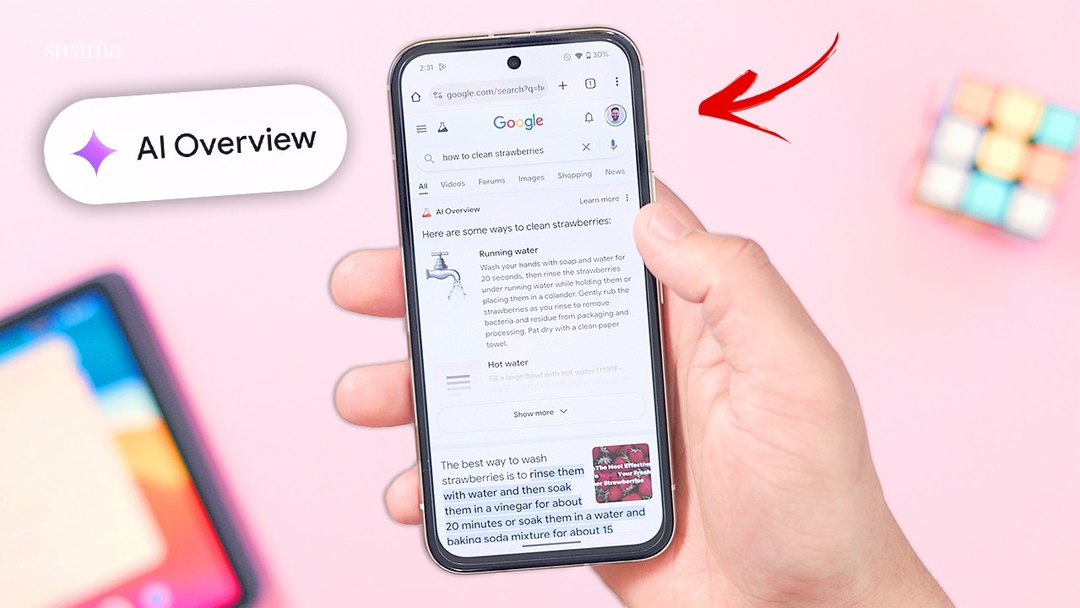
For years, getting to the top of Google meant getting people to your website.
A small brand could publish useful content, build authority, target the right keywords, and eventually earn a place on page one. The formula was fairly straightforward: someone searched, Google presented the options, and the brand competed for the click.
Now, Google can answer the question before the searcher reaches the website.
That changes the economics of organic search. It has disrupted the whole structure of online search and discovery.
AI Overviews can place a generated answer above traditional results, pulling information from several websites and presenting it directly to the searcher. Google introduced AI Overviews in Indonesia in September 2024, and AI Mode followed in Bahasa Indonesia in September 2025. Google has also expanded AI search to more countries and languages as it develops a more conversational way to search.
For a small brand that depends on organic discovery, this creates an uncomfortable question: If Google can answer the customer's question without sending them to your website, what happens to the brand behind the answer?
Well, the search result is becoming the “answer” customers are looking for. Take the following scenarios, for example:
This was the old search journey we’re all used to:
Question → Google → website → brand
So simple, right? Then AI comes along and changes the whole sequence:
Question → AI-generated answer → sources → maybe a website
And when consumers use ChatGPT, Gemini, Perplexity, or other generative AI platforms, the journey can look even more different:
Question → conversation → recommendations → brand consideration
This distinction matters because visibility and website traffic are no longer the same thing.
A brand can appear in an AI-generated answer without receiving the visit that would once have followed a Google ranking.
Research from Ahrefs illustrates the scale of the change. Its February 2026 update analyzed 300,000 keywords and found that the presence of an AI Overview was associated with a 58% lower click-through rate for the top-ranking organic result. The comparison used December 2025 data and accounted for the underlying decline in CTR for informational searches.
The figure is significant, but it needs context. AI Overviews are not appearing uniformly across every search, industry, or intent. Semrush's analysis of more than 10 million keywords found that AI Overviews appeared for 15.69% of the keywords it tracked in November 2025, after reaching 24.61% in July. The same research found that AI Overviews were increasingly appearing on commercial, transactional, and navigational searches, rather than staying limited to simple informational questions.
The important change is therefore less about one percentage point or another. Search is moving from a list of destinations towards an answer experience.
Large, established brands have something smaller businesses often lack: existing demand.
Someone searching for Nike, Apple, or Samsung already knows the name. A website visit may come from a customer who has already decided which brand they want to investigate.
Small businesses often play a different game.
They rely on searches such as:
These searches are opportunities for discovery. The person may have a problem, but they may not have a brand in mind. That makes informational content especially important.
A small business might spend months creating an article designed to answer one of these questions. It earns a strong ranking. Google then uses information from the article to help generate an AI Overview.
The brand has achieved visibility. The searcher gets the answer. But the website gets nothing.
That is where the relationship between SEO and brand building becomes interesting. A brand can become a source of information without becoming the brand that the customer remembers.
This is the part of AI search that deserves more attention.
AI can summarize information extremely well. If ten businesses publish essentially the same article about "how to choose a digital marketing agency", an AI system has little reason to send users through all ten articles.
It can synthesise them. That creates a strange incentive for marketers.
For years, SEO encouraged brands to answer more questions. Now generative AI is becoming very good at answering those questions for the user.
The more interchangeable the content becomes, the easier it is to summarize.
This is one reason Swarna believes the next phase of content marketing needs to move beyond producing pages that simply satisfy search intent.
The question becomes: Why would someone want to hear this from this particular brand?
That question leads to a very different kind of content.
People are also changing the way they ask questions.
Traditional search tends to compress a problem into keywords: "best CRM Indonesia"
A conversational query gives the search engine much more context, such as:
"I'm running a small Indonesian business with five salespeople. We need a CRM that is easy to set up, works well for WhatsApp leads, and doesn't have the cost or complexity of an enterprise platform. What should we consider?"
That second query tells the system what the person is trying to accomplish, what constraints they have, and what trade-offs matter.
AI search is built for this kind of interaction, as traditional online search forces you to manually wade through endless scrolls of result pages.
Google's introduction of AI Mode in Indonesian reflects the same direction. Users can ask longer and more complex questions and continue the conversation instead of starting a completely new search for every part of the problem.
The shift is also happening outside Google.
Harvard Business Review reported in 2025 that 58% of 12,000 consumers surveyed had used generative AI tools for product or service recommendations, compared with 25% in 2023.
McKinsey's 2025 research found that half of the consumers surveyed were already using AI-powered search. Its analysis projected that AI-powered search could influence $750 billion in US consumer spending by 2028.
The numbers point towards a broader change in behavior: people are giving AI more of the research job.
For marketers, that means content needs to answer a question while also giving the brand a reason to remain part of the conversation.
There is an easy way to respond to the rise of AI search: produce more content.
That means more FAQs, "What is..." articles, "10 ways to..." posts, and variations of the same topic.
AI makes this process even faster. It can research a topic, create an outline, generate an article, and produce multiple variations in minutes. Yet, the problem arises when every competitor does the same thing.
The web fills with content that has been carefully designed around keywords but contains very little that belongs specifically to the brand.
We recently explored this issue in our previous article on the "templating" of content creation. The concern is not the use of templates or AI itself. Templates can make production more efficient. AI can help teams research, analyse, and develop ideas.
The problem appears when the template becomes the thinking.
When every brand answers a question in the same format, the content becomes easier for people to skim and easier for machines to summarise.
That creates a strange outcome wherein the more generic the content becomes, the less reason there is to visit the company that published it.
As brands have become reliant on AI and automation, there is still a need to understand the importance of SEO, technical health, search intent, useful content, link authority, and structured information.
But there is another layer. A brand needs to be easy for search systems to understand and interesting enough for people to remember. That means content needs more first-party information.
These details give content substance that a generic article cannot easily reproduce. They also give AI systems clearer information about what a brand actually knows.
Research into AI citations is already pointing in this direction. Ahrefs has examined why AI systems cite some pages more often than others, while Semrush has documented how original, data-rich research can become a source for AI-generated answers.
The opportunity is therefore bigger than trying to "rank in AI." It is about becoming a source worth citing.
There is another step that matters even more.
But the strongest form of discovery happens when the customer searches for the brand itself.
Consider the difference between "best language learning platform Indonesia" and "KitaCakap reviews."
The first search is category discovery. The second is brand consideration.
That difference matters because branded search is much harder for a competitor or an AI-generated summary to intercept.
This is where SEO, social media, content, creators, public relations, communities, and brand strategy begin to work together.
Indonesia is particularly suited to this kind of connected discovery. A customer might discover a brand through TikTok, search Google for reviews, ask ChatGPT for an opinion, visit Instagram, check a marketplace listing, and then return to the company's website.
The journey does not have to begin or end with Google.
The website still matters. It simply has a different job: validating, explaining, and converting.
And, increasingly, it gives search engines and AI systems the information they need to understand the brand.
An academic case study involving Nook Premium Coliving in Indonesia provides an interesting example.
The research examined a business where organic search accounted for around 40% of monthly leads. After AI Overview disruption, the study reported a 59.9% decline in blog clicks, even while SEO leads reached 12,247.
The result points to a useful distinction: fewer blog clicks do not automatically mean that search has stopped contributing to growth.
The role of search can change.
The research explored TikTok as a way to support branded search and lead generation alongside SEO. In other words, the answer to declining search clicks was partly to create demand elsewhere.
That approach makes sense because a customer who has already encountered a brand is much more likely to search for that brand than someone who has never heard of it.
Swarna sees this as the next challenge for small and emerging brands.
Don’t abandon Google because AI Overviews exist. Stop treating it as the entire discovery strategy.
Legrand already had the credibility of a global brand, but its digital presence needed to connect more effectively with Indonesian audiences. Swarna combined social media management, content, and audience strategy, helping the brand reach 16,000 Instagram followers and 5,000 LinkedIn followers.
KitaCakap combined SEO, social media management, and paid advertising with content built around audience engagement and Indonesian cultural context. The agency reports a 3,486% year-on-year increase in website traffic and an 81.5% increase in user engagement.
These results matter for a reason beyond the numbers. They show why discovery works better when a brand has multiple ways to reach people.
A person can encounter a brand before they ever search for it. That encounter changes the next search.
Website sessions remain useful, but they need company.
A brand should also watch whether people are searching for its name, returning to its website, mentioning it in other channels, engaging with its content, and arriving through AI platforms.
Search Console impressions can tell a different story from clicks.
A page may continue appearing for thousands of searches while receiving fewer visits because an AI Overview answers the query above it. That is a reason to examine the intent behind the traffic.
A short informational question may be easy for an AI system to answer.
A search involving a product comparison, service evaluation, purchase, account, tool, or human expertise has a different commercial value.
This means the goal of content strategy needs to move closer to qualified discovery.
The question is no longer simply: How much traffic can this article generate?
It becomes: Does this content bring the right person closer to this brand?
The brands that adapt well will still create content for search.
They will simply give that content more to say.
They will publish original research instead of repeating statistics found in ten other articles.
They will document customer experiences instead of manufacturing generic case studies.
They will use local knowledge instead of translating global advice word for word.
They will give experts a voice instead of making every article sound like the same corporate handbook.
They will use AI where it helps with research, analysis, and production, while keeping strategic and creative judgement with people who understand the brand and its audience.
Most importantly, they will build reasons for customers to search for them by name.
That is a healthier relationship between SEO and brand building.
For some searches, the evidence says it can take a meaningful share of clicks away from traditional organic results. But traffic is only one part of the story.
Search itself is changing.
Google is answering more questions directly. AI platforms are taking on more product research. Consumers are becoming more comfortable describing their problems conversationally. Social platforms continue to influence discovery. And small brands now compete for attention across all of these spaces at once.
The brands facing the greatest risk are those whose entire digital strategy depends on answering generic questions that AI can summarise in seconds.
The stronger position belongs to brands that give people something worth remembering. Their content can still answer the question. Their expertise can still appear in search. Their information can still be cited by AI. But the brand itself becomes part of the reason the person keeps looking.
That is where Swarna sees the opportunity.
We combine SEO, content, social media, paid media, analytics, and creative thinking to help brands build demand across the places where people actually discover and evaluate them.
For small and emerging brands, the goal is bigger than winning a Google position.
It is building enough relevance that when someone asks, "Who should I consider?", the brand has a reason to be part of the answer.
If AI is changing where your customers search, Swarna can help rethink where your brand needs to show up. Talk to our team to get things started.

Our SEO and content prowess isn't magic, but it's as close as it gets here at Swarna!
Let's transform your online presence, step into the spotlight, and be seen.


.svg)