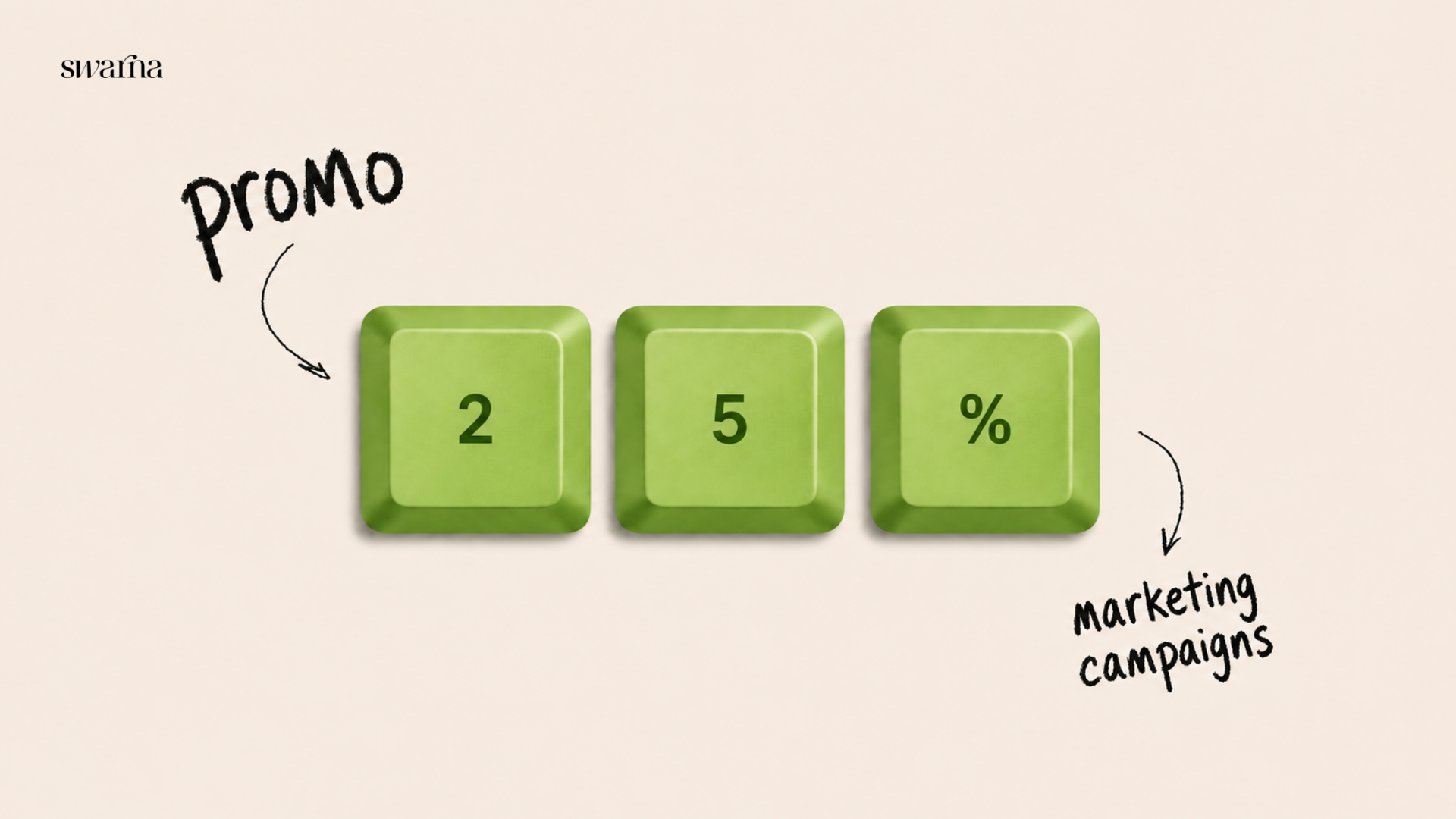
A decade ago, September 9 was just another day. Today, it triggers a reflex. Your thumb scrolls, your cart fills, and your brain registers a number that feels like a win, even when your wallet disagrees.
E-commerce platforms did not just create shopping events and pick numbers out of thin air. They rewired the calendar itself. Dates that once meant nothing now operate as big shopping events.
In Indonesia, this machinery runs on numbers that make headlines. Harbolnas 2025 moved Rp36.4 trillion, with 40% of monthly consumer goods purchases happening during these windows. The headlines celebrate the winners. They rarely mention the brands that joined the party, paid for the drinks, and left with nothing but a hangover.
Let’s take a look at the math behind the magic, why double-date campaigns work for some brands, how they quietly destroy others, and what small brands in Indonesia can do differently.
The double-date phenomenon did not start in Jakarta. It started in 2009, when Alibaba turned Singles' Day into a sales experiment. The idea traveled fast. Southeast Asian platforms adapted it to local culture. Shopee built 9.9. Lazada claimed 10.10. Indonesia added Harbolnas. These events created a predictable pattern: consumers learned to wait while sellers learned to panic. It’s like the numbers you see in a slot machine, in the hope you get the best deal there is.
These events evolved beyond simple discounting. They became full festival economies. Gamification layers like Shopee Shake and Lazada Moji-Go turn shopping into a game. Livestream hosts perform theater for six hours straight. Pre-sale windows stretch across weeks. The architecture is deliberate: artificial scarcity, social proof, and algorithmic urgency working together to compress decision-making into seconds.
The scale is hard to ignore. Indonesia's e-commerce market reached roughly $71 billion in GMV this year. Projections put it near $190 billion by 2030. During Harbolnas 2025, more than 1,300 businesses participated, and local products accounted for 45.6% of sales.
Collectively, 86% of Southeast Asian Internet users have bought during a double-digit festival. For 43% of them, it was their first digital purchase. These numbers explain why platforms keep investing billions in user acquisition before each event. They also explain why small brands feel they have no choice but to show up.
For brands that prepare, double-date campaigns deliver real results. Nielsen data shows sales lifts between 201% and 500% during these windows, with ROI consistently landing between 101% and 200%. Indonesia leads Southeast Asia in online promo participation at 94%. The traffic is real, the intent is high, and the cultural momentum is undeniable.
In Indonesia, it's Shopee vs. Tokopedia battling for online shopping supremacy.
So, what are the forces that drive this?
Traffic arbitrage
Platforms pour advertising budgets into attracting users before these events. Brands that participate ride a wave they did not pay for.
Algorithmic favoritism
Sellers who join promos get better placement, flash-sale slots, and livestream features. Opting out means sinking in search results.
Cultural ritual
In Indonesia, shopping during Harbolnas or Singles Day has become a social activity. Consumers expect to buy, which lowers the cost of persuasion.
The Annaira Collection, a Muslim fashion MSME selling on Shopee, found that live selling combined with double-date campaigns explained 92% of its sales variation. The formula works, until it becomes the only formula a brand knows.
The problem starts when the party ends.
Small brands often slash prices 50% to 70%, then pay platform commissions that now sit between 8% and 15%, fund voucher co-payments, and buy ad boosts to stay visible. The revenue spike masks a profit collapse. A brand can double its sales and still lose money.
Repeated participation rewires customer expectations. A brand that discounts four times a year trains its audience to wait for the fifth. The price anchor drops. Full-price sales become harder. This is the margin death spiral, and it is difficult to escape once it starts.
Then there is the inventory trap. Overstocking for 11.11 leaves dead capital sitting in warehouses come January. Understocking means algorithmic penalties and lost ranking. Both outcomes hurt.
Advertising costs make the math worse. Customer acquisition costs have risen 60% over five years, now sitting between $45 and $70 per customer. During double dates, auction-based ad costs spike further. The game favors brands with deep pockets. Small sellers are playing poker with borrowed chips.
Platform algorithms in 2026 make this harder. Recommendation systems now prioritize sellers with historical conversion data, review velocity, and ad spend. These are exactly the metrics small brands lack. The slot machine rewards the house.
Even traffic does not guarantee conversion. Cart abandonment sits at 70.19%, with nearly half of consumers citing extra costs like shipping and fees as the reason they quit. A flood of visitors means nothing if the economy does not close.
The Indonesian government actively pushes MSME participation in events like Harbolnas. Over 1,000 MSMEs joined the 2025 edition. But the infrastructure of these events - logistics spikes, ad auctions, and livestream production - favors enterprise players.
Small sellers now face a dual-platform reality. They must manage Shopee for stability, TikTok Shop for discovery, and Instagram for brand equity. Each platform demands different creative, pricing, and fulfillment rhythms. Spreading thin is the default, and it is exhausting.
The deeper issue is structural. Small brands need promo revenue to survive, but promo participation erodes the brand equity that would let them survive without promos. It is a cash-flow paradox. The medicine and the disease come from the same bottle.
AI is shifting the battlefield. Discovery is moving from keyword search to behavior-driven, multimodal recommendations. Brands without first-party data or content velocity simply do not surface. Being small is a visibility problem as much as a budget problem.
Video commerce is now the default in Indonesia. The country saw 2.6 billion video-commerce transactions in 2025, a 90% jump from the previous year. Double dates are now won or lost in livestreams and short-form video, not static banners.
Platforms are also changing their own incentives. They are shifting from GMV maximization to margin capture through Retail Media Networks and higher seller fees. This means promo success depends more on paid visibility than organic merit. The house always wins, but now it takes a bigger cut.
AI is no longer just an analysis tool. It now executes campaigns. Meta lowered its Advantage+ thresholds for smaller advertisers. Tools like Klaviyo use predictive segmentation to optimize send times. The gap between brands that use AI and brands that do not is widening fast.
Trust is also becoming a currency. NielsenIQ found that while free shipping and discounts remain essential, trust built through influencers, official store badges, and personalized recommendations is increasingly central to purchase decisions during mega sales. Consumers are tired of being sold to. They want to buy from brands they believe.
We treat these events as strategic moments, not calendar obligations. We look at whether a specific brand should participate, how deep the cut should go, and what happens after the sale ends.
Our work starts with pre-campaign intelligence. We use AI-driven market analysis to predict which products, price points, and platforms will deliver ROI for a specific brand. Blind participation is expensive. Selective participation is profitable.
We design content for shoppertainment. Indonesia's consumers want to be entertained into buying, not simply sold to. Our video and livestream strategies compete on cultural relevance rather than discount depth. This protects margin while driving conversion.
We build the anti-discount playbook. Bundle logic, loyalty mechanics, and exclusive-access drops create the feeling of a deal without eroding brand equity. A customer who feels special buys at full price. A customer who feels smart only buys at 50% off.
We orchestrate cross-platform rhythm. Managing Shopee for stability, TikTok Shop for discovery, and owned channels for retention is complex. We handle the choreography so small brands do not spread themselves thin.
Finally, we engineer post-promo retention. Converting a one-time buyer into a repeat customer requires behavioral email flows, SMS timing, and first-party data capture. We close the loop that most small brands leave open.
The proof is in the work. Baxe saw 963 app installs within three months of early release. Legrand Indonesia gained 16,000 new Instagram followers and 5,000 LinkedIn followers in one year. Happy Soju and KitaCakap grew by telling better stories, not by cutting deeper.
The double-date phenomenon is not dying. It is maturing. The brands that win in 2026 and beyond have stopped asking how deep they should discount. They started asking how they can show up so memorably that customers would buy even without a sale.
Small brands do not need bigger budgets. They need sharper strategies. The calendar is crowded. The algorithms are biased. The competition is loud. But the opportunity is real for brands that know how to read the numbers behind the noise.
At Swarna, we turn promotional chaos into strategic growth. If you run a small or upcoming brand in Indonesia, book a free session with us. We will read your data, map your calendar, and build a campaign that grows your brand without shrinking your margin.

Unveil the secrets of ghost engagement on Instagram with the help of our expert marketers at Swarna!
Let's help you banish the specters and embrace authentic connections for lasting online success.


.svg)