There's a small shop near almost every residential street in Indonesia.
The owner knows your name. They ask about your mother. They remember that you take two spoons of sugar in your coffee. You don't visit because they sent you a discount code. You visit because trust accumulated one greeting at a time.
WhatsApp is the digital version of that shop.
And that's what makes WhatsApp marketing in Indonesia different.
Indonesia had 230 million internet users and 180 million social media user identities at the end of 2025, according to DataReportal's 2026 Indonesia report. At the same time, Indonesia's digital advertising market is forecast to grow from $3.23 billion in 2025 to $4.51 billion by 2031.
The opportunity isn't simply that Indonesians use WhatsApp. It's that messaging already feels personal.
Most brands still approach WhatsApp like a billboard: broadcast a promotion, push a product, count the clicks, and move on.
The better approach is to think like the warung owner.
Show up. Listen. Remember. Help. Then sell when the conversation makes it natural.
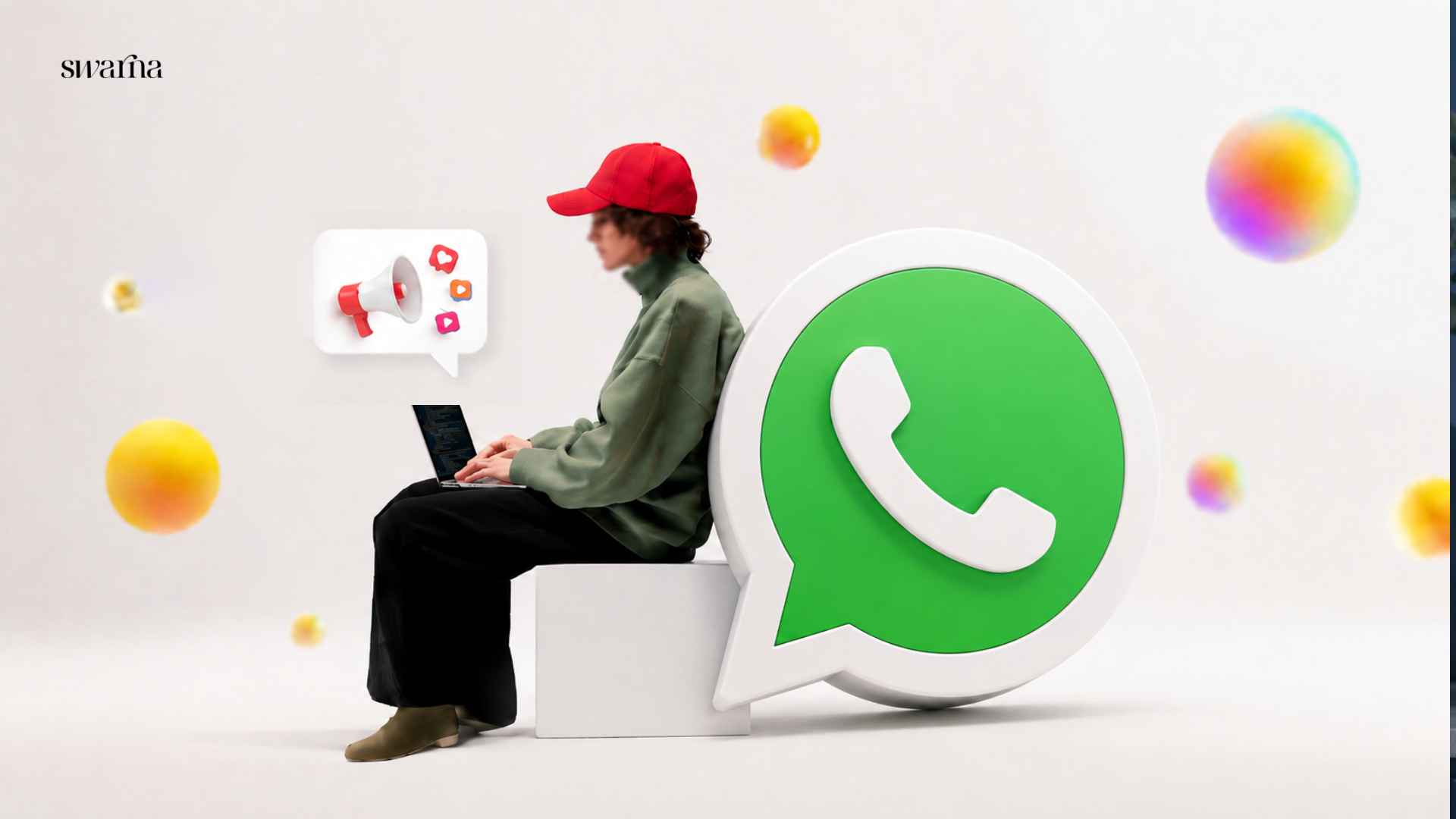
WhatsApp marketing is the use of WhatsApp to attract, engage, convert, and retain customers through direct conversations. Unlike traditional broadcast advertising, it can combine advertising, customer service, product discovery, sales assistance, and follow-up in the same conversational channel.
That distinction matters.
A customer looking at a pair of shoes might want to know whether the sizing runs small. Someone considering an education program might want to ask about schedules. A prospective financial-services customer may have questions they aren't comfortable answering through a generic website form.
A website can provide the information. A conversation can provide reassurance.
That's why WhatsApp works particularly well for products and services where people need to ask questions before they buy.
The strongest WhatsApp strategies don't treat the platform as a destination. They treat it as part of a customer journey.
A simple journey looks like this:
Discover → Chat → Qualify → Recommend → Convert → Retain
And WhatsApp remains available for follow-up, support, and repeat purchases. That removes a surprising amount of friction.
VIP Leather Craft, an Indonesian premium leather retailer, tested purchase-optimized ads that directed people to WhatsApp. The campaign generated 28% more sales and a 21% lower cost per purchase than its previous conversation-optimized approach.
The lesson isn't simply "use WhatsApp ads." It's to match the advertising objective to the outcome you actually want.
WhatsApp marketing should feel like a natural conversation and not a cumbersome marketing process. Here are key principles you should take note of:
Indonesian customers aren't moving through your marketing funnel in a neat sequence on a laptop. They're checking their phones between meetings. While commuting. While waiting for dinner. While sitting on the sofa at night. Your funnel needs to respect that behavior.
That means short-form creative, clear calls to action, and as few unnecessary steps as possible.
Click-to-WhatsApp advertising is powerful because it removes one of the biggest gaps in digital marketing: the distance between seeing something interesting and being able to ask a question.
Instead of: Ad → Website → Landing page → Form → Follow-up
You can create: Ad → WhatsApp conversation
The brand stops being a message on a screen and becomes someone who can answer.
For high-consideration products, that distinction matters even more. Financial services, education, B2B solutions, property, automotive, and premium products often involve questions that a landing page cannot anticipate.
The customer doesn't necessarily want more content. They want an answer.
Indonesians use multiple digital platforms, but that doesn't mean brands need to shout across all of them at once. The smarter strategy is to use each channel for what it does best.
That makes click-to-WhatsApp advertising particularly useful when trust needs to be established before conversion. And WhatsApp doesn't have to replace other channels.
SMS, for example, remains useful for functional communication such as OTPs, delivery updates, and payment reminders. WhatsApp can take the relationship further through recommendations, questions, feedback, and follow-up.
The distinction is simple: SMS tells. WhatsApp talks.
That doesn't mean every customer interaction belongs on WhatsApp. It means brands should give each channel a job instead of using every channel to broadcast the same message.
AI can make WhatsApp conversations scalable.
But scale without context creates a different problem: a chatbot that technically answers the question while making the customer feel like they're talking to a machine.
Indonesian conversations carry nuance.
The choice between formal and informal language matters. Politeness matters. Context matters. People switch between Bahasa Indonesia, English, and regional expressions. And the appropriate tone can change depending on whether the customer is asking about a product, making a complaint, or dealing with a sensitive issue.
A good WhatsApp chatbot shouldn't simply translate an English conversation into Bahasa Indonesia. It should understand how Indonesians actually communicate.
The best model is usually hybrid:
Bank Raya provides a useful example. Its WhatsApp Business Platform implementation produced a reported 97% improvement in average case-resolution time, while its average live-agent first response time through WhatsApp was three minutes.
IALF Indonesia similarly used automated WhatsApp support to improve response times and reported an 85% improvement in customer satisfaction.
The lesson is important: Automation shouldn't remove the human touch. It should create more room for it.
In a warung, success isn't measured by how many people walk past the door. It's measured by who comes back. WhatsApp marketing deserves the same mindset.
Don't stop at messages sent, contacts reached, or clicks generated. Track what happens inside the conversation.
A useful WhatsApp measurement framework includes:
The ultimate goal is to maximize useful conversations.
Toshiko's WhatsApp implementation, for example, grew weekly message volume by 93% within 12 weeks across Vietnam and Indonesia. More importantly, nearly half of its conversations were two-way exchanges, demonstrating that the channel supported actual dialogue rather than simply generating outbound messages.
That's a better definition of engagement.
A practical WhatsApp marketing strategy can be built around six stages.
1. Attract
Use social content, search, influencers, and Meta advertising to create awareness. The creative should make the reason for starting a conversation obvious.
2. Start the conversation
Use click-to-WhatsApp ads, website CTAs, QR codes, or social profiles to move interested people into WhatsApp. Don't make customers hunt for the chat button.
3. Qualify
Ask only the questions needed to understand intent.
For example:
Good qualification feels like help. Bad qualification feels like an interrogation.
4. Recommend
Use the information from the conversation to provide a relevant product, service, or next step. This is where WhatsApp becomes more powerful than a generic landing page. The customer isn't receiving the same answer as everyone else. They're receiving an answer based on what they've told you.
5. Convert
Make the next step obvious. That could mean: completing a purchase, booking an appointment, requesting a quote, speaking to a salesperson, or submitting an application. Remove unnecessary friction.
6. Retain
The conversation shouldn't end when the transaction does. Use WhatsApp for appropriate follow-ups, service updates, feedback, recommendations, and repeat-purchase opportunities. That's how a campaign becomes a relationship.
The next stage of conversational marketing isn't simply more messages. It's more connected commerce.
WhatsApp is increasingly becoming a place where discovery, customer service, product information, and sales can happen in the same environment. Meta is also expanding business AI capabilities on WhatsApp, including tools designed to answer customer questions, recommend products, and help businesses drive sales.
For Indonesian brands, the strategic question is therefore changing.
From "Should we market on WhatsApp?" to "Which parts of our customer journey should become conversations?"
That might be product discovery. It might be lead qualification. It might be customer service. It might be repeat purchases. Or it might be all four.
The brands that figure this out early will have an advantage not because they send more messages, but because they understand when customers want to talk.
The most successful brands on WhatsApp won't necessarily be the ones with the biggest databases or the largest advertising budgets.
They'll be the ones that show up consistently, remember preferences, solve problems quickly, and know when not to sell.
That's the warung principle.
Technology should make a brand feel more human, not less.
At Swarna, we call this data-driven imagination: using analytics, AI, and automation to create interactions that still feel human.
We've seen the value of that approach firsthand. For KitaCakap, our work contributed to an 81% increase in user engagement year over year. For Baxe, we drove 963 app installs within three months of its early release. For Happy Soju, we helped generate 279% growth in social media followers.
The numbers matter. But the principle behind them matters more.
Start with the customer. Understand the behavior. Use technology to remove friction.
Then build the kind of experience people want to come back to.
If your brand is ready to stop knocking on doors and start being invited in, book a free strategy session with Swarna.
We'll read your fortune, then build it.

Experience the enchantment of data-driven creativity, where every project is a spell waiting to be cast. We have a team of sorcerers ready to weave digital narratives that captivate, inspire, and elevate your brand to new heights.
Let the magic unfold at Swarna and redefine the possibilities of digital marketing. Together, we create brilliance that transcends the ordinary.


.svg)