Think about this particular real-world scenario.
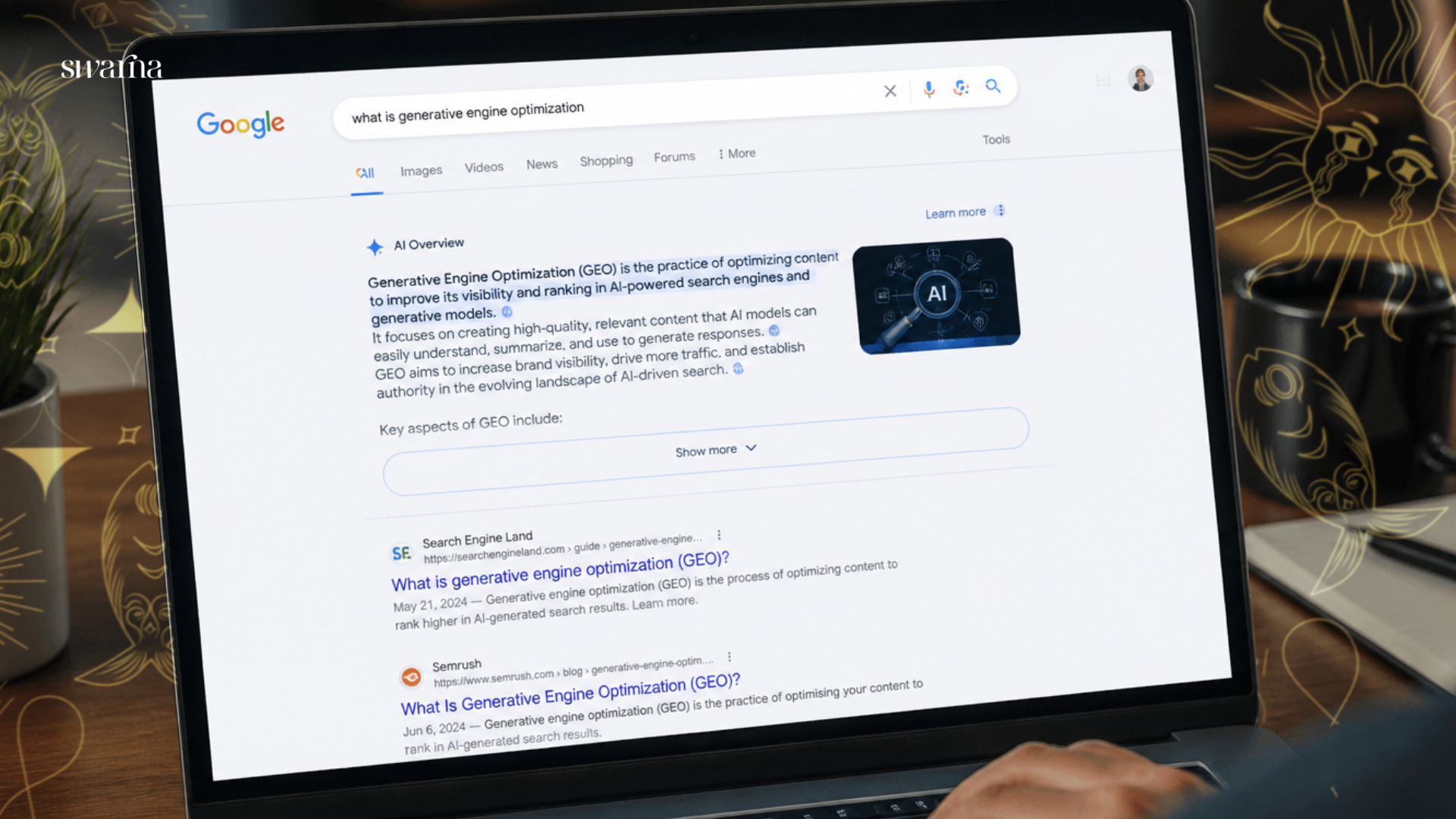
You are a B2B software company, and your website traffic has dropped by 70% overnight. Your content is still ranked on page one of Google SERPs while your content team is doing everything right by the book. Yet, users are no longer clicking through. Google’s AI Overviews had started answering the questions directly on the search page, and your carefully developed online presence suddenly hangs in the balance.
It’s no longer an isolated case.
In fact, this story is repeated across industries, as many B2B websites have lost traffic. HubSpot, the company that practically invented inbound marketing, saw blog visits fall from 13.5 million to roughly 6 million monthly, a 70-80% collapse, because its broad "how-to" content was exactly what AI summaries handled best.
The click is not dying because of bad SEO. It is dying because the search experience itself has changed.
Consider the scale of what is happening. In the United States, 58.5% of Google searches now end without a click. On mobile, that figure rises to 77%. When Google's AI Mode is active, 93% of queries resolve without a single click on an organic result.
The user base for AI search is growing fast. In 2026, 31.3% of the US population will use generative AI search. ChatGPT has passed 800 million weekly users. Google Gemini exceeds 750 million monthly. These are not niche tools anymore. They are the primary interface through which people discover brands, compare products, and form opinions.
Yet most marketers are unprepared. Only 14% currently track AI citation visibility. The other 86% are optimizing for a world that no longer exists.
As every major LLM behaves differently, brands and digital marketers should understand how these AI systems select what to mention.
Here is a critical finding that most brands miss: the sources these models cite are almost entirely different from each other. Analysis of 100,000 prompts across ChatGPT and Perplexity found that only 11% of cited domains overlapped. Nearly 89% of AI citations came from completely different sources depending on which model the user queried.
That means, you cannot optimize for one AI and call it done. You need presence across ChatGPT, Perplexity, Claude, Gemini, and Qwen, and each one reads the web through a different lens.
Another thing to understand is that the citation landscape is also volatile. Between 40% and 60% of cited sources change month-to-month across Google AI Mode and ChatGPT. Visibility in AI is not a stable ranking you can set and forget. It is a moving target that requires continuous monitoring.
Two new fields have emerged to address this. Answer Engine Optimization (AEO) focuses on direct answers in featured snippets, voice assistants, and AI summaries. It uses FAQ formatting, schema markup, and 40-60-word direct answers placed early in content.
Generative Engine Optimization (GEO) goes further. It is the practice of structuring, writing, and publishing content so that AI language models cite it when answering user queries. The term was formalized in a 2024 academic paper from Princeton, Georgia Tech, and IIT Delhi. By early 2026, most enterprise marketing teams had a GEO initiative. Most small and medium businesses had not, which leaves a significant first-mover opportunity.
The two disciplines work together. AEO gets you into the answer box. GEO gets you into the AI-generated response. Traditional SEO still matters for commercial-intent queries, but its share of total discovery is shrinking.
When an AI Overview appears on a search result, only 8% of users click a traditional organic result, compared to 15% when no overview is present. That is a nearly 50% reduction in click opportunity.
But here is the twist: brands that are cited in AI Overviews earn 35% more organic clicks and 91% more paid clicks than those that are not. The citation itself drives trust, and that trust carries over to the links that do get clicked.
AI-driven search query volume grew 340% year-over-year in the first quarter of 2026. The brands that were already optimized for citations captured that growth. The ones that were not saw their share of voice shrink invisibly.
Think of your brand's digital presence as operating across three layers.
Layer one is traditional rankings. This is where you have spent the last decade optimizing. It still drives value for transactional queries, but its share of total discovery is declining.
Layer two is SERP features: AI Overviews, featured snippets, and People Also Ask. These give you visibility without traffic. The user sees your brand, learns from your content, but never visits your site.
Layer three is AI citation visibility. This is the fastest-growing and least-measured layer. It is being cited inside ChatGPT, Perplexity, or Claude responses without a search ever taking place in the traditional sense.
Most brands are still optimizing only for layer one. The winners are building systems that operate across all three.
The academic research on GEO identified specific tactics that increase citation rates. Pages optimized for entity clarity, structure, and contextual flow were cited up to 58% more often in AI-generated summaries than non-optimized pages.
Here is what that means in practice:
Structure content for extraction
Place a complete, direct answer in the first 100 words. Use question-format headers. Add FAQ sections with schema markup. AI systems scan for extractable answers, and if they cannot find one quickly, they move on.
Publish original data
AI models need fresh statistics and research to cite. A "State of the Industry" report with methodology, sample size, and clear findings earns citations that generic listicles cannot.
Build entity authority
AI systems cite brands they recognize as authoritative entities in a domain. This means consistent representation across your website, Google Business Profile, LinkedIn, industry directories, and third-party publications. It also means owning a vocabulary: when AI needs to explain what something is in your niche, it should reach for your definition.
Engineer trust signals
Named authors with credentials, editorial policies, review dates, and cited sources all increase the probability of citation. AI systems are trained to favor content that demonstrates accountability.
Target the right third-party sources
Reddit, LinkedIn, and YouTube rank among the most-referenced domains by major LLMs. Earning mentions on these platforms, in context, builds the citation web that AI systems traverse.
Monitor across platforms
Because most citations differ between ChatGPT and Perplexity, you need to track visibility on each platform separately. Tools like Otterly.ai, Profound.co, and manual query tracking can surface where you appear and, more importantly, where you do not.
One of the hardest parts of this shift is measuring it. A brand could be cited in thousands of AI-generated responses without seeing a single direct-attribution visit in Google Analytics.
But the effect is real. When AI Overviews launched, branded homepage visits increased 13% in the first two months, then 21% over the following year, as users who encountered a brand in an AI summary later searched for it directly.
An increase in branded search volume without a corresponding increase in paid spend often signals growing AI-driven awareness. People hear about you from an AI response, then type your name into Google later. Traditional analytics miss this because the AI interaction happens in a separate system.
Here is the uncomfortable truth: many marketers cite AI-driven search changes as their single biggest challenge in 2026. Most agencies are still selling keyword rankings and backlink counts. They are optimizing for layer one while layers two and three determine an increasing share of brand discovery.
The agencies that will matter in the next five years are the ones that understand how ChatGPT, Perplexity, Claude, Gemini, and Qwen each read and cite content. They are the ones that track AI Share of Voice, not just organic traffic. They are the ones that build brand ecosystems AI systems naturally want to reference.
We are built on the principle of data-driven imagination. We have worked with brands from Indonesia and beyond. Our approach to the AI search shift follows these principles.
First, we treat the entity foundation as the starting point. Before any content work, we ensure your brand is consistently represented across the digital ecosystem, with schema markup, aligned descriptions, and clear concept ownership.
Second, we build an answer architecture into existing content. We audit your highest-traffic pages and restructure them for extractability, adding FAQ sections, summary boxes, and direct answers in the first 100 words.
Third, we strengthen trust signals. Named authors, credentials, editorial policies, and fresh data are not afterthoughts. They are structural requirements for an AI citation.
Fourth, we design for multi-model presence. Because ChatGPT, Perplexity, and Claude cite different sources, we build citation distribution strategies that earn mentions across all of them, not just one.
Fifth, we measure what matters. We track AI citation frequency, branded search trends, and assisted conversions from AI exposure. We do not pretend that traditional organic traffic tells the whole story.
The shift is already underway. The question is whether your brand will be part of the answer or part of the silence. Let’s discuss your options today.

At Swarna, we'll help your brand fly high so your reach shines brighter like the stars!
We don't just break limits, we redefine them.


.svg)